Learnings from DEME's pioneering LNG-powered River Scheldt dredger
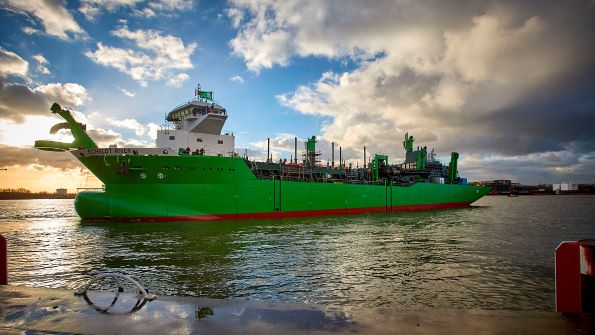
The launch of DEME’s dual fuel trailing suction hopper dredger took place on 14th January 2017,at Royal IHC’s shipyard in Krimpen aan den IJssel, Netherlands. Credit: Royal IHC
While uncertainties about what future low-carbon and zero-carbon fuels to bank on, companies must find practical ways to reduce their carbon footprints and meet international emissions targets. Liquefied natural gas (LNG) has been viewed by many as an affordable and available “bridging fuel”, providing a pathway to lower emissions, while issues of costs, infrastructure and market measures are ironed out for zero carbon fuels. However, dual fuel LNG vessels are not being delivered in overwhelming numbers, with the order book averaging two a year since 2017, according to S&P Global data.
Belgium-born dredging giant DEME was an early champion of sustainability in the international dredging sector, investing heavily in R&D for alternative fuels and new technologies to reduce the environmental impact of an industry that underpins world shipping and trade. The company has a plan to reduce its greenhouse gas (GHG) emissions by 40% by 2030, relative to 2008 levels.
DEME’s first active foray was with LNG, including the 2017 launch of the trailing suction hopper dredger (TSHD) Scheldt River. Signposting the company’s confidence in LNG, DEME has to date in total four dual fuel TSHDs in its fleet, Minerva, Bonny River and Spartacus, as well as a dual fuelled cable installation vessel and offshore installation vessel.
Scheldt River was one of the first vessels in the dredging world to operate on LNG in a dual fuel hybrid engine configuration, the 7950m3 capacity vessel was commissioned with Royal IHC and built in the Netherlands. Capable of dredging to a depth of up to 34m, Scheldt River has seen active service on significant projects across Europe and has helped point the way towards the next generation of sustainable service. So, seven years on from the first dual fuel vessels, what are the learnings for DEME, Royal IHC and the wider dredging industry?
Future proofed fleet
A strategic commercial decision, DEME has said that investing in LNG-fuelled vessels is designed to help “future proof” its fleet by being able to operate on LNG, diesel fuel or other low-carbon fuels. The business advantages are clear: it can help them to gain a competitive advantage for tenders and projects with specific sustainability and emissions goals, or a requirement to meet strict international emission requirements.
Speaking at the launch of its first dual-fuel vessel Minerva in June 2017, Bart Verboomen, Head of DEME’s Technical Department, stated: “We operate in an industry where our customers invest in a green energy supply and implement measures to limit the impact of their operations on the environment. It is a logical step for DEME to make the transition to cleaner types of fuel, such as LNG to meet customer requirements and to comply with changing legislation and emission reduction targets.”
And it is not just lower carbon emissions that help meet customer, legislation and emission reduction targets. LNG-fuelled engines emit other less harmful emissions, such as nitrogen oxides, sulphur oxides and particulate matter. Speaking to Ceda Industry News, Benny Mestemaker, senior specialist new fuels & drive systems, from Royal IHC, who built the Scheldt River for DEME, explained that these were lower by -85%, -99% and -95% respectively.
Mestemaker explained that LNG is not just cleaner than distillate fuel but also affordable and will remain so “for decades to come”. They noted that when compared to diesel price in euros per energy content at the time of investment, LNG was “significantly lower”.
Confronting challenges
With any new fuel there are teething issues. Critics of LNG and its claimed environmental benefits point to methane slippage (the release of unburned natural gas in a ship’s engine after combustion). However, Mestemaker at Royal IHC is confident that these issues are being handled, “and are expected to be resolved in the coming decade with new engine technologies and exhaust gas after treatment”, keeping LNG a viable option for many operators.
In 2022, DEME worked with Wärtsilä to create a greenhouse gas (GHG) reduction package for Scheldt River and its dual-fuel offshore cable laying vessel Living Stone. Speaking about the work in a case study, DEME project engineer Bert Wuyts said that following heavy investments in LNG-vessels the collaboration helped “take our efforts to reduce our emissions a step further”. He went on to explain that while the vessels had “very different” profiles “they are our first vessels to operate on dual-fuel engines [so] they were good candidates for our emerging impact reduction programme.”
Wärtsilä developed a software upgrade for engine management across both vessels, powered by its 34DF engine. The company states that it provides “significant” GHG emission reductions, particularly between part-load operation and idling. “This package delivers measurable changes that bring us closer to our goals” said Wuyts. “In addition, the emission measurements have demonstrated compliance with stringent EU Stage V limits for all emissions – we’ve found that the emission reduction at low loads is especially impressive.”
Design deviations
Designing for dual-fuel vessels brings its own set of challenges to overcome. When integrating LNG into the design of the Scheldt River, for example, Royal IHC had to resolve issues around LNG’s lower density (an issue that will also be faced with other future low-carbon fuels), which requires more storage space onboard than traditional fuels. This makes the LNG tanks heavier and creates a need for more buoyancy and stability in the design.
In addition, Jaimy de Bruine, specialist engineering alternative fuels, Royal IHC, told CIN that current dual fuel engines require a diesel fuel pilot to ignite the LNG. “This means that two complete fuel systems are required, which increases costs and space requirements,” they said. Safety zones on deck limit the placement of other equipment and passage routes for the crew, “especially on highly integrated dredging vessels like the Scheldt River”, they added.
De Bruine stressed that LNG-fuelled dual fuel engines also have less load ramp and load step capabilities, meaning they require an energy storage for peak shaving to prevent the engine changing back to diesel operation. And fuel storage creates its own design challenge, not to mention safety training requirements for crews. LNG is stored at around 110 Kelvin (-163 degrees celsius). “This extreme cold liquid requires special safety measures and technical solutions such as double-walled piping and additional spaces and components in the engine room arrangement,” de Bruine explained.
Safety is paramount
Safety is of critical concern when handling LNG. It is important that companies institute bespoke safety courses to equip crew with an understanding of handling procedures, emergency response protocols and the operation of specialised equipment.
In alignment with industry standards such as ISO 20519 and the IGF Code, a robust Safety Management System (SMS) must include detailed procedures for the transfer, storage, operation, and maintenance of LNG. Crew members should undergo extensive training covering the operational risks and management, complemented by practical simulations to handle hazardous situations effectively.
The "2024 MTF ISM Guideline Report" emphasises the importance of such training so that crews are well-equipped to manage the unique challenges posed by LNG in order to significantly enhance operational safety and efficiency.
The "2024 MTF ISM Guideline Report" also underscores the necessity of integrating comprehensive risk management practices, recommending "structured identification, analysis, and evaluation of risks associated with alternative fuels."
For DEME, a notable investment has been in simulation training. Bureau International Marine (BIM) of Antwerp introduced LNG bunkering simulator training in collaboration with Exmar Academy. These simulator courses can be substituted in part for mandated shipboard experience. BIM has carried out combined IGF basic/advanced simulator courses at the shipowner’s premises in Antwerp.
And what of LNG’s future role for DEME and more broadly across the dredging industry? While Royal IHC’s Mestemaker acknowledges that other alternative fuels are being slowly introduced, such as methanol and hydrogen, “these fuels do not yet have the infrastructure” that LNG currently has available, “and struggle with their own issues such as availability, price, energy density and technology availability and price”. Until these barriers are overcome, it seems the bridging fuel may continue to stretch out for some more years to come.
While the advice given in this editorial content has been developed using the best information available, it is intended purely as guidance to be used at the user’s own risk. No responsibility is accepted by CEDA or by the Intent Communications Ltd or by any person, firm, corporation or organisation who or which has been in any way concerned with the furnishing of information or data, the compilation, publication or any translation, supply or sale of this Guidance for the accuracy of any information or advice given herein or for any omission herefrom or from any consequences whatsoever resulting directly or indirectly from compliance with or adoption of guidance contained therein even if caused by a failure to exercise reasonable care.